
Usually a printed document, issued in various dimensions, containing the signature of the President of Congress (during the American Revolution), and later signed by the President of the United States and Secretary of State. There is a general absence of decorative engraving, but these forms will display the United States seal and the usual customs stamps, signatures, etc.
Letters of Marque were licenses granted by a monarch or government to privately-owned vessels, enabling them under certain conditions to war against the shipping of an enemy nation. The word marque, from the French, was used in this sense to mean a pledge to seize or capture. Vessels carrying these documents were popularly known as privateers.
There were nearly 800 American privateers commissioned during the REvolutionary War, 365 during the period of the undeclared war with France, ca. 1798-1800, and more than 500 sailed against the British during the War of 1812. In the most limited terms, a privateer was a private armed vessel carrying no cargo, devoted exclusively to warlike use, and operating under a commission obtained from the government. Some of these commissions were called Letters of Marque, and were issued to armed cargo-=carrying vessels authorizing them to engage enemy shipping during th course of their commercial voyages. By 1812, Letters of Marque and Privateer Commissions were essentially the same document, and it is certainly not grossly incorrect to refer to all such vessels as privateers.
Application and issuance procedures varied from one period to another. During the American Revolution the Continental Congress adopted a printed form with blank spaces for the name of the vessel, owners and master, and figures for tonnage, guns an crew. These blank commissions, signed by the President of Congress, were sent out to the United Colonies, who assumed primary responsibility for the regulation and conduct of their own privateer fleets. By 1812 a shipowner applied in writing tho the Collector, or in some cases directly to the State Department. If approved, he would then sign a bond, usually for a sum ranging between $5,000 and $10,000 (depending upon the size of his vessel or crew) to insure his ship’s compliance with the conditions of the Letter of Marque or Privateer Commission. The document itself, containing the signatures of the President and the Secretary of State, was then issued to the shipowner through the Customs Service, and remained valid until recalled by the government or canceled through a violation of the bond.
Letters of Marque were abolished by the Congress of Paris in 1856, and the practice of privateering was considered obsolete by the end of the nineteenth century. Letters of Marque and Privateer’s Commissions can be considered truly unique and valuable items in any maritime collection.
Commission granted by the “United States in Congress assembled” to the ship Samson during the American Revolution. The words Letter of Marque and privateer do not appear on the document, but its identity is made clear by instructions for the vessel “to fit out and set forth…in a warlike manner…and by force of arms to attack, subdue, seize, and take all ships and other vessels…belonging to the King or Crown of Great Britain….” The document measures approximately 16″ X 13″, is printed on heavy grade paper, and displays the congressional seal in the upper left-hand corner. (MSS. Coll., Peabody Museum, Salem, MA. Photo by Mark Sexton.)
By 1812 the distinction between a Letter of Marque and a Privateer’s Commission was difficult to establish. Often the vessel’s description (i.e. number of guns or the size of her crew) is the most accurate indicator as to whether it was an armed merchantman or a private warship. The document illustrated here, belonging to the ship Alexander, is typical of the commissions granted by the government during the War of 1812. Printed on heavy grade paper, approximately 16″ X 13″. (Mss. Coll., Peabody Museum, Salem, MA. Photo by Mark Sexton.)
Bond for a Letter of Marque signed by the master and owners of the “private armed vessel” Providence, 8 August 1812. Bonds were intended to insure compliance with the instructions, and regulations specified in the commission or Letter of Marque. In this example, the signatories are bonded to the United States for the sum of five thousand dollars until such time as the document is recalled by the President. (Courtesy of Rhode Island Historical Society.)
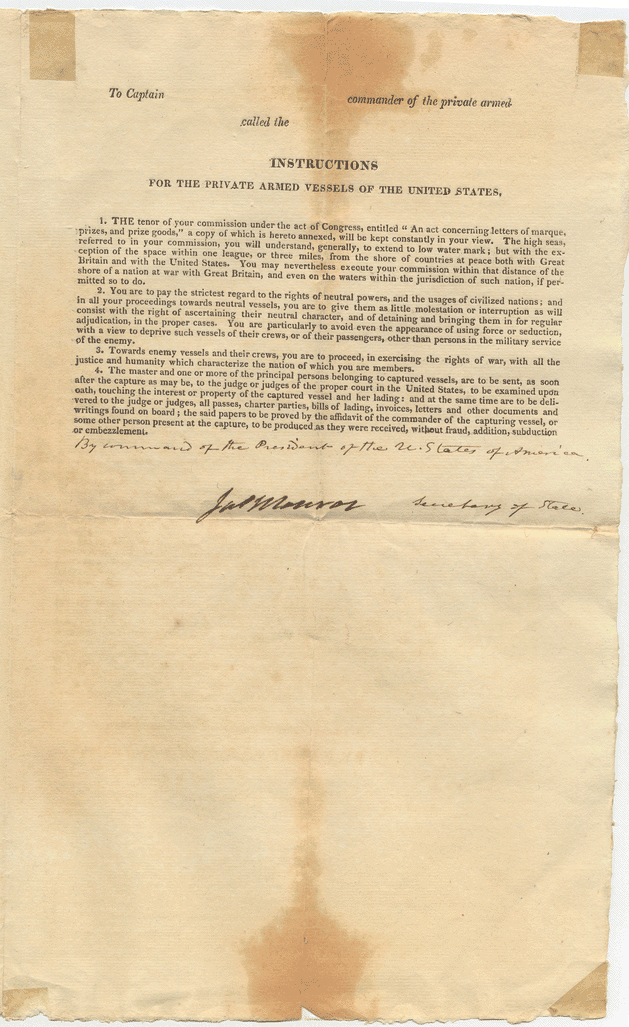
Instructions to accompany Letters of Marque were given to the commanders of these private armed vessels after the bond was signed and the commission was obtained. The example illustrated here was attached to a copy of the Act Concerning Letters of Marque, Prizes and Prize Goods, passed in June, 1812, which further outlined the conduct of American privateers on the high seas. It displays the signature of James Munroe, Secretary of State.
