Introduction
Acknowledgments
Abstract Log
Articles of Agreement
Bill of Health
Bill of Lading
Bill of Sale (1856)
Bond for Duties (1825)
Bonds for Foreign Voyages
Charter Party
Classification Certificate (1863)
Clearance Certificate
Coasting Permit (1809)
Consular Certificates (Miscellaneous)
Contribution Certificate "Morning Star" (1856)
Convoy Instructions (ca. 1800)
Crew List
Customs Certificates and Forms (Miscellaneous)
Drawback Forms and Certificates
Enrolment Certificate
Freight Circular (1857)
Freight List (1857)
Letter of Marque/Privateer Commission
License (Coasting/Fishing Vessels)
Logbook (1828)
Manifest
Marine Insurance
Marine Society Membership Certificate (1839)
Master Carpenter's Certificate/Measurement Certificate (1853)
Master's Certificate (1861)
Mediterranean Passport/Sea Letter
Oaths and Affirmations
Passenger List
Pilot's License
Port Rules and Regulations
Portage Bill (1852)
Receipts (Miscellaneous)
Registry Certificate/Ship's Register
Sailing Card (ca. 1860)
Sailing Orders (1830)
Seamen's Protection Certificate
Shipbuilding Agreements and Contracts
Steamboat Regulatory Documents
Whalemen's Shipping Paper (1840)
Appendix
Selected Bibliography
Page 1 of 2 Next >>
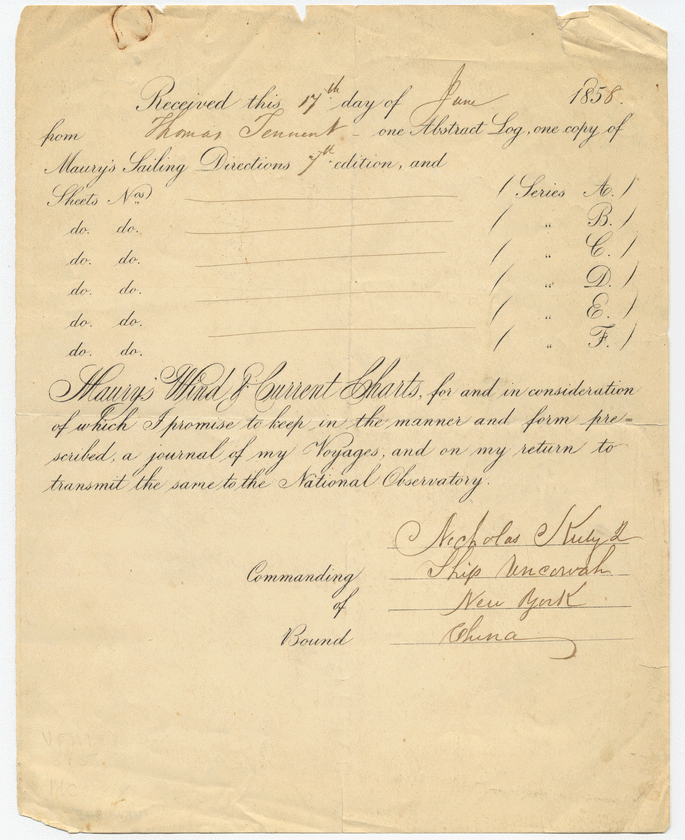
Occasionally a shipmaster might extract specific kinds of information from his vessel's logbook and record them in a separate volume, sometimes called an Abstract Log. Possibly the kind most often found in maritime collections is the Abstract Log of navigational data recommended by the Maritime Conference at Brussels is 1853 and formulated in part by Lt. Matthew Fontaine Maury, USN. (illustrated). These logs were maintained by the master or mate during the voyage, and then returned to the National Observatory in Washington, D.C., in exchange fro the use of Maury's Wind and Current Charts.
American Maritime Documents, 1776-1860 - Stein, Douglas L.
Abstract Log
Page 1 of 2 Next >>
Occasionally a shipmaster might extract specific kinds of information from his vessel's logbook and record them in a separate volume, sometimes called an Abstract Log. Possibly the kind most often found in maritime collections is the Abstract Log of navigational data recommended by the Maritime Conference at Brussels is 1853 and formulated in part by Lt. Matthew Fontaine Maury, USN. (illustrated). These logs were maintained by the master or mate during the voyage, and then returned to the National Observatory in Washington, D.C., in exchange fro the use of Maury's Wind and Current Charts.
* Funding for digitization provided by: The Andrew W. Mellon Foundation